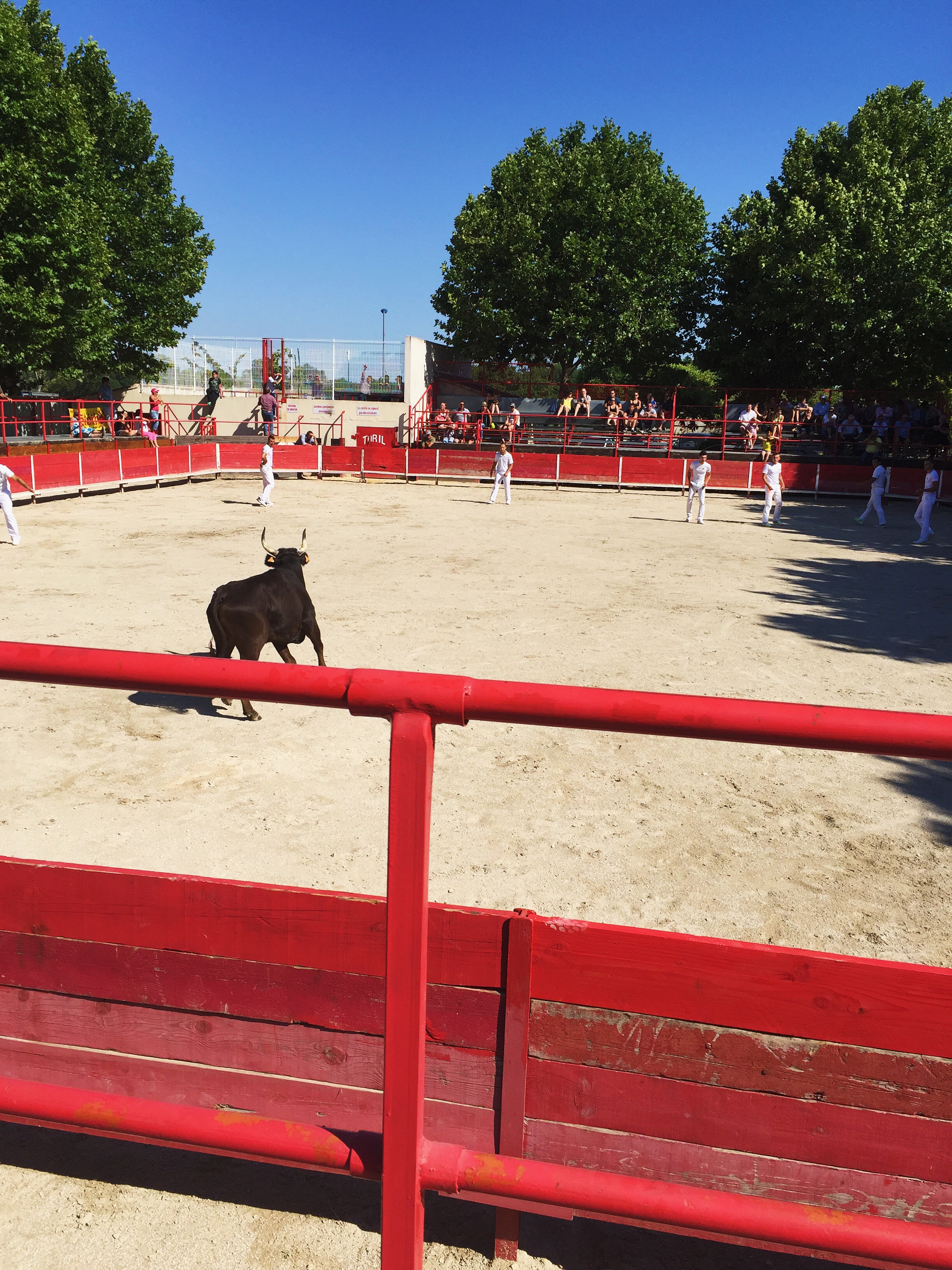
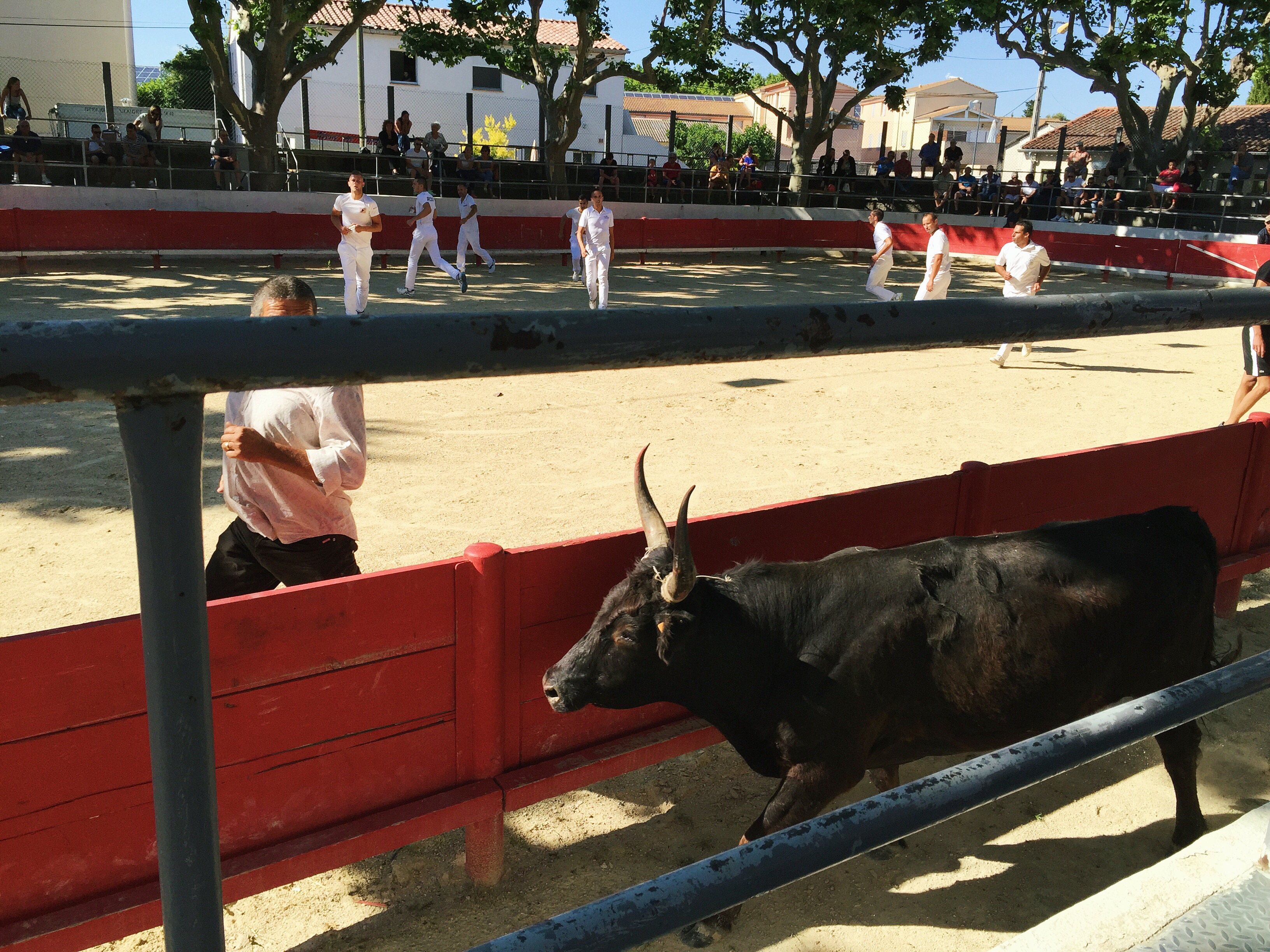
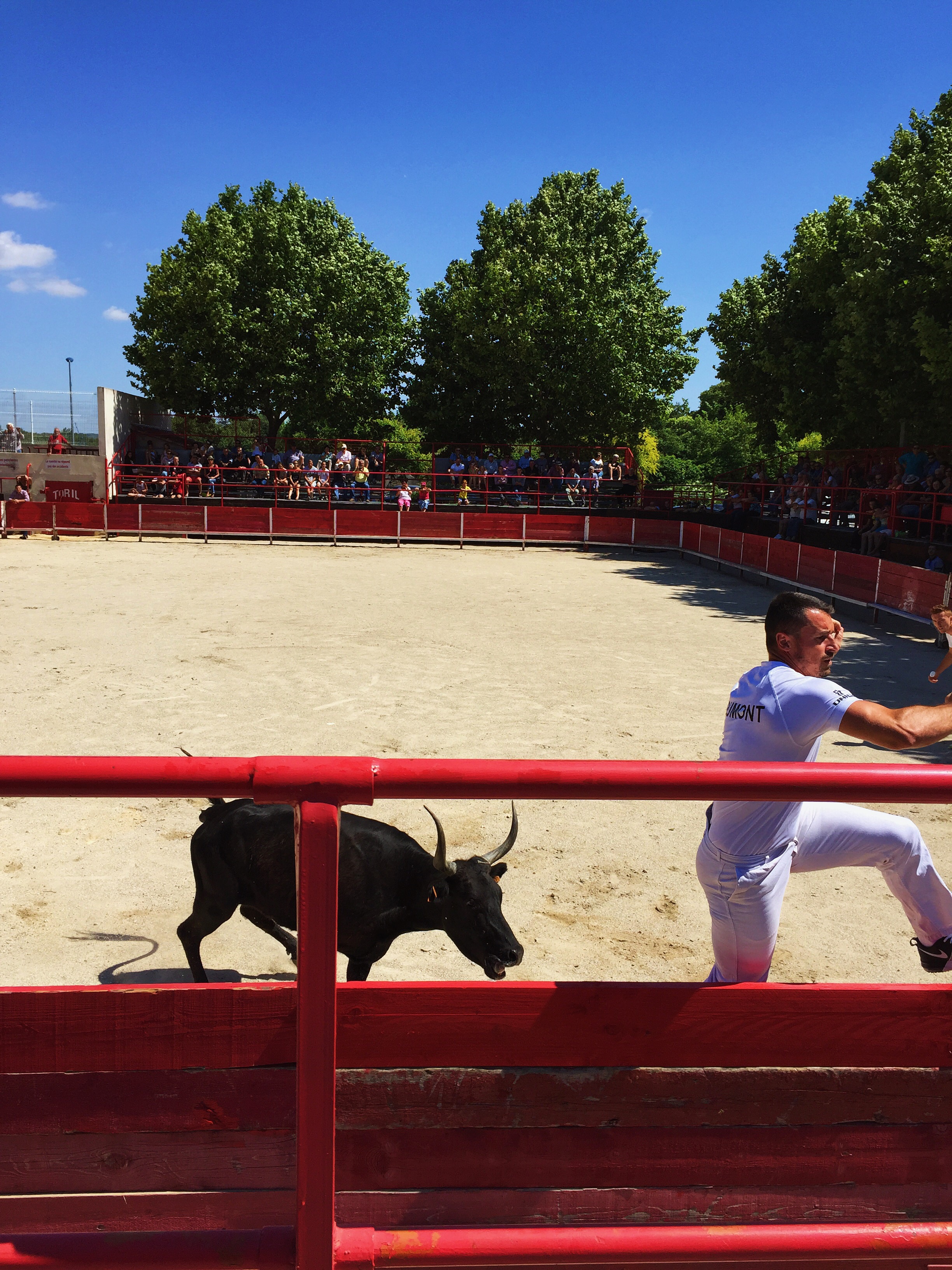
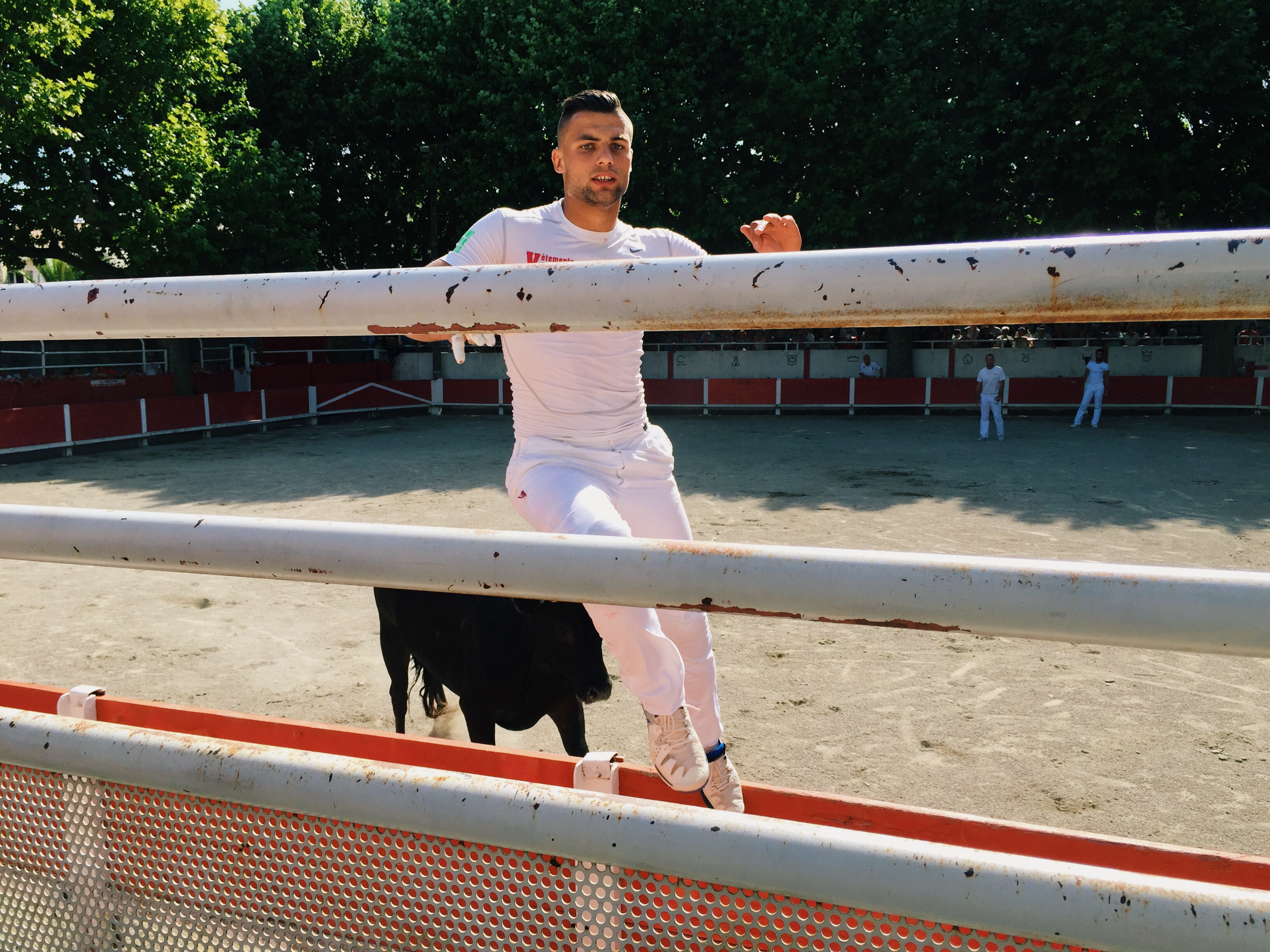

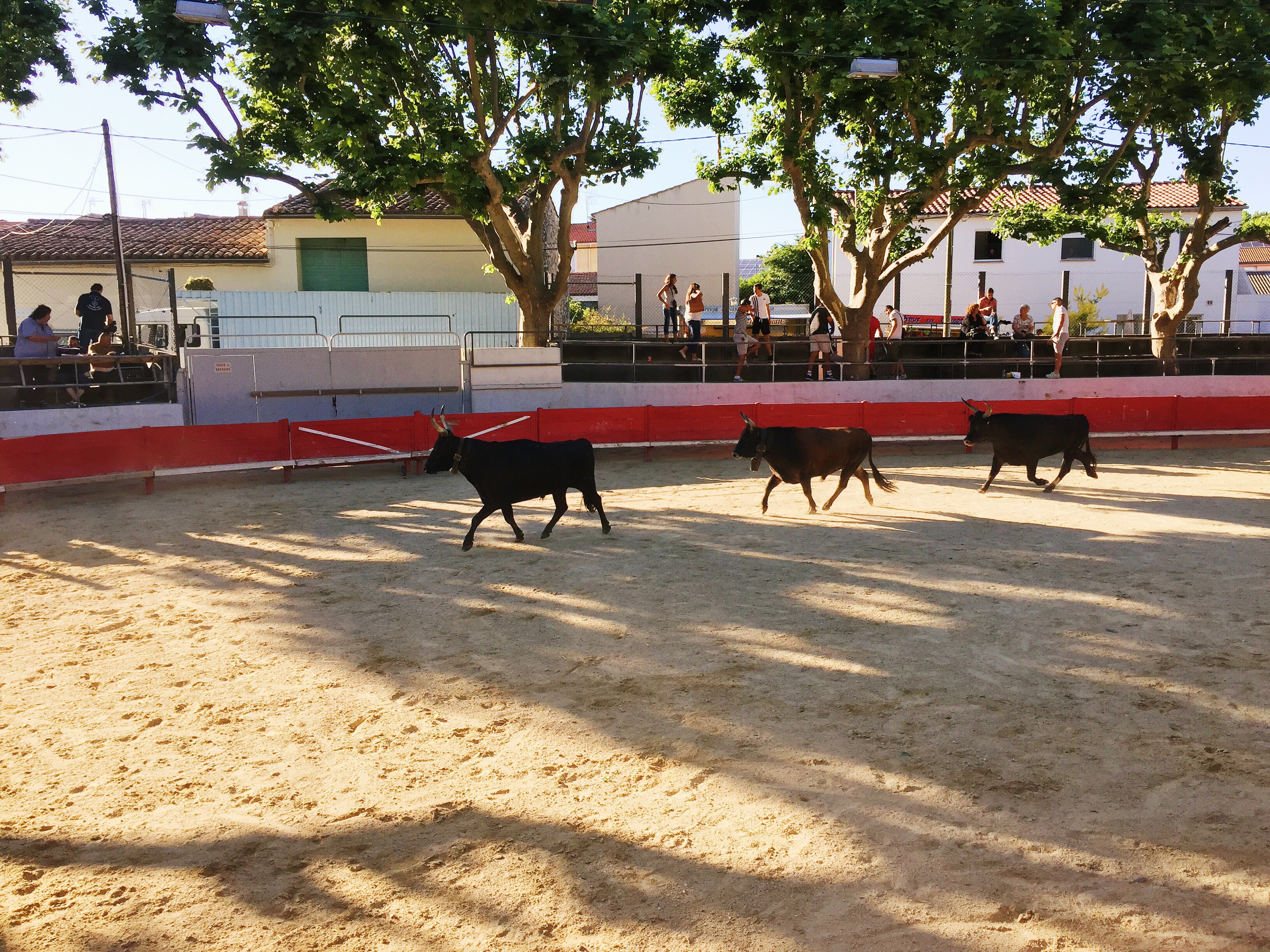
Les Courses Camarguaises (bull games) are a traditional sport in this region of France, in which men (les razeteurs or raceteurs) in white outfits (always white) use special tools called les racets, or les crochets to remove “les attributs” from a bull’s horns. A racet in the razeteur’s fist is visible in the 5th picture above. Les attributs are made up of 5 different items: la cocarde (a small red ribbon) tied between the horns, les glans (one or two tassels made of yarn or cord), each dangling from one horn, and les ficelles (strings tied around the base of each horn).
The object of the game is for the razeteurs to use their racets to cut each attribut from the bull’s horns, running to safety by leaping over the ring to the rails in the stands as the bull gives chase. The razeteurs are only allowed to attempt to cut an attribut if the bull is moving (ie chasing him). In hockey language, it’s offside if the bull stops chasing the razeteur, or if the razeteur fails to entice the bull to chase him. In the ring with the razetuers are 2 “tourneurs”, former razeteurs, who distract the bull if the razeteur is in danger, or who encourage the bull to chase if it becomes distracted (like a rodeo clown).
The racet is specially made so that it does not injure the bull. The razeteurs can win money for each attribut that they successfully remove, and the prize money rises throughout the duration of the game. The order of attribut removal is: la cocarde, each glan, then each ficelle. Prize money is provided by local businesses who act as sponsors, with the game’s emcee announcing each additional prize: “deux euros de plus par la Cave d’Hercule pour la première ficelle!”.
Obviously, removing the attributs from the horns is not easy, so raising the prize money at intervals only adds more excitement to the game as the razeteurs take more and more chances to challenge the bull.
The real victor in the ring is the bull; people cheer him on, and when the bull performs particularly well, or is especially agile, a piece from the opera “Carmen” is played, which causes the crowd to cheer loudly. Each round lasts about 15 minutes with a different bull, and there are 6 or 8 rounds per game separated by one 20 minute break at the halfway point. At the end of a round, if the bull (still full of fight) refuses to leave the ring, the simbeu is sent out to encourage him back to the bull pen.
The Courses Camarguaises season is long, running from March to October. Many small towns in the region have their own “arène” in which the games are held. They are a big draw, and the atmosphere is always festive and upbeat.
Having completed the guided tour with Camargue Autrement, D and I came to understand that the bull is a very well-respected animal held in high regard in this region. The courses Camarguaises is one way that the bull is celebrated for its might and power.
This sport is entirely different from the feria, and the Spanish toreador in which the bull’s ultimate destiny is death in the ring. In the Courses Camarguaises, the bull is never killed, and spends his entire life (up to 20 years on average) participating in the sport. At the end of his life, a Courses Camarguaises bull is not slaughtered for meat, but is instead buried in respect for a life spent as fierce competitor.
 MEMORIES LIE...