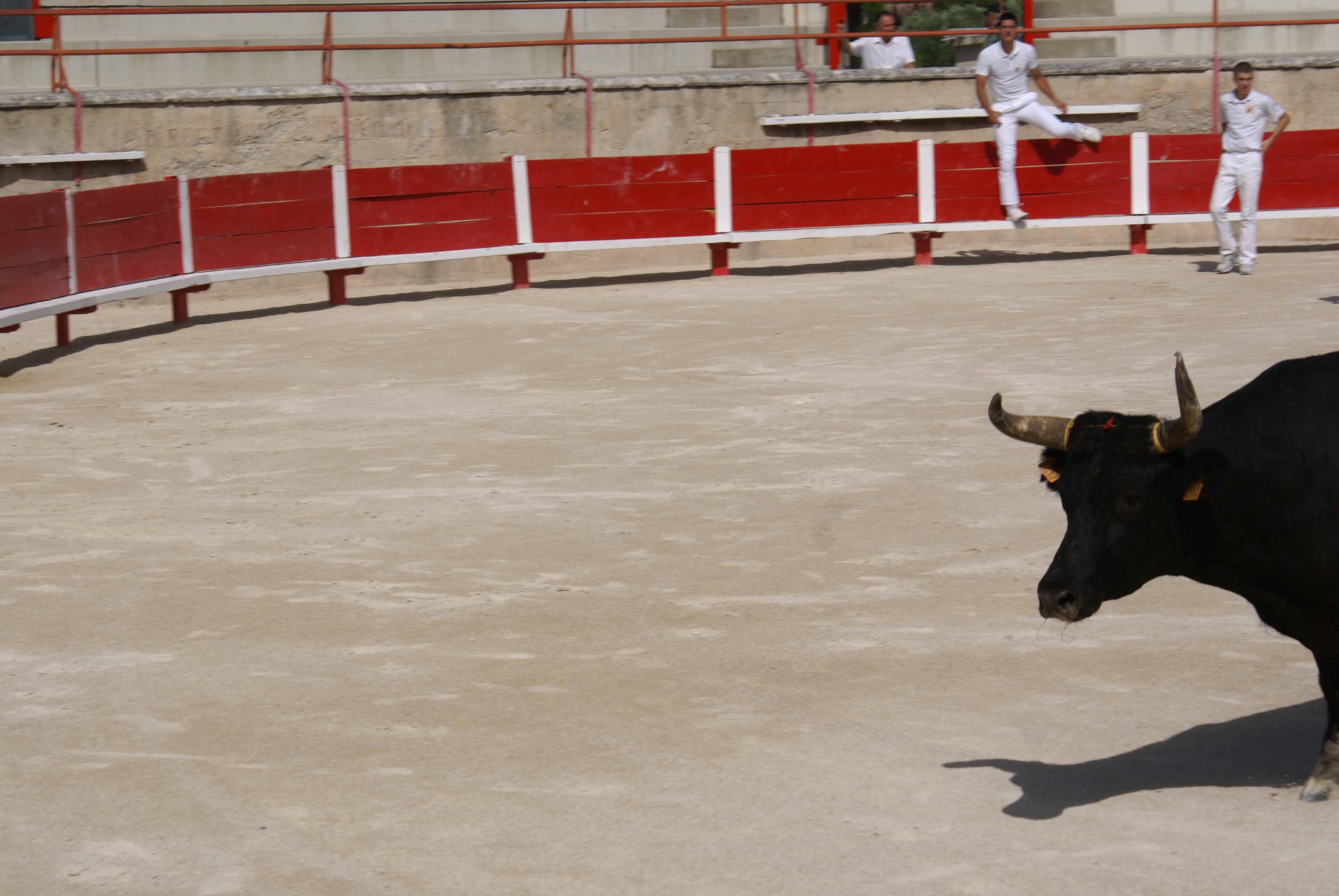

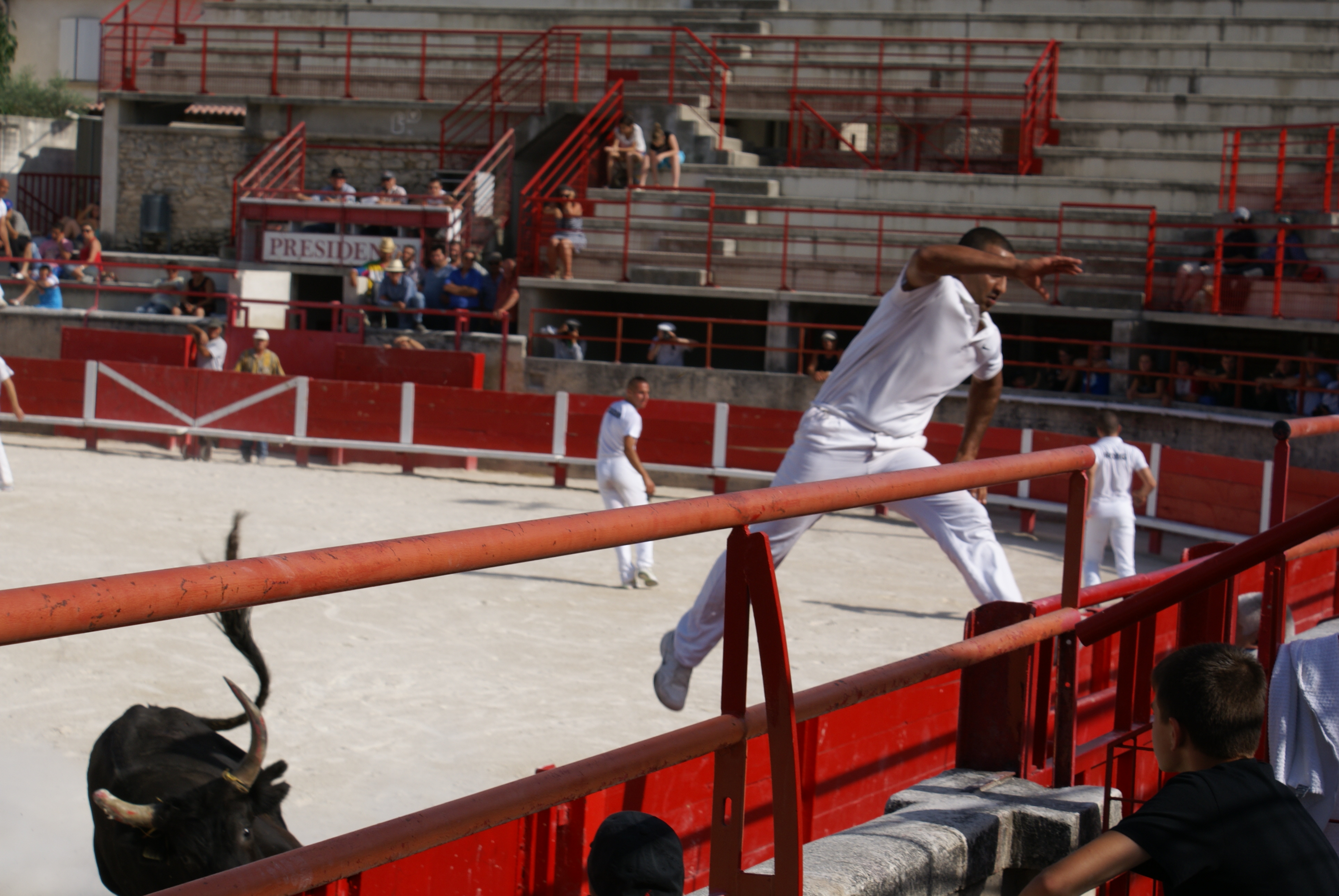


The bull is an animal that is revered in the south of France (Provence and the Languedoc-Rousillon), just as it is in Spain. The area has a tradition of bull games, called “Les Courses Camarguaises”, in which “les raseteurs”, young men trained in the sport, use a small hand-held tool to try and cut “les ficelles” from a bull’s horns. These “ficelles” are strong yellow cords that are wound around the base of the bull’s horns.
Typically, six raseteurs and 2 handlers are in the ring with a single bull. The raseteurs have 15 minutes to try and remove the “ficelles” from the bull’s horns, and there are usually 6 or 7 different bulls in one event. The bull chases after them, and the raseteurs display their considerable acrobatic and gymnastic talents by running quickly and then leaping from inside the arena, over the red wooden fences onto the bars of the first row of spectator stands. In order to cut the ficelles, the raseteur must make a split-second decision whether he has enough time to reach towards the charging bull and attempt to cut the ficelles…or whether he should just run and leap for safety!
The bulls are not killed in this game; this is an important distinction between bullgames and bullfights. In fact, the crowd often cheers for the bull, and a snippet from the opera “Carmen” is played each time the bull performs a particularly impressive move, such as knocking a raseteur off his feet, or giving a good chase that causes the raseteur to leap a great height or distance to safety. At the end of each round, the bull receives a big round of applause, especially if he has retained some of his ficelles!
We watched two of these “Courses Camarguaises” over the last couple of days. The first was in St. Rémy de Provence, and the second was in Tarascon.We noticed that some of the bulls did not immediately run for the pen at the end of their rounds, even when the raseteurs had already made their exit and the bull was alone in the ring. If the handlers were unable to coax the bull to exit, another bull, wearing a bell around his neck, was sent into the arena where he would make his way to the other bull and lead him out.
This bull with the bell is called a “Simbeù”. The simbeù is apparently chosen for his innate easy-going disposition and natural tendancy to lead the other bulls. The simbeù does not compete in the Courses Camarguaises; his sole job is to help herd the bulls, and to provide them with a sense of calm and ease whether they are in the field or in the arena.The simbeù is considered an essential part of the team, and an indispensable aid to the farmers who raise the bulls and the “gardiens” who train and care for the animals.
 MEMORIES LIE...
Lucky you for having seen this amazing sport (or is it a sport)
LikeLike
Hi Dad,
It must be a sport because there is a federation that regulates it to ensure the bulls are not mistreated. The season runs from March to September. The “raceteurs” are all very skilled (you’d be impressed to watch them) so I think they are atheletes in their own right. They were very exciting games to watch!
LikeLike